09 · Controls
Rotational Position Control (PID Tuning)
UC San Diego · MAE 171A Feedback Control · Winter 2026
Modeled a 2-DOF torsional control system on real DSP-controlled hardware and tuned a PID controller by root locus design, closing a steady-state error the calculated gains left unresolved.
- 20.8%
- overshoot (target <25%)
- 1.40 s
- settling time
- 0.1%
- steady-state error
What
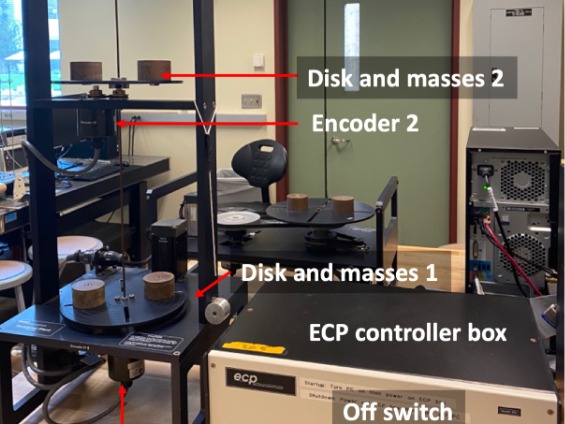
- Modeled and controlled a 2-DOF rotational torsion system on a real DSP-controlled test rig.
- Built for UCSD's MAE 171A feedback control course.
How
- Extracted moment of inertia, torsional damping, and stiffness from 1-DOF step-response experiments, validating the model against simulation before closing the loop.
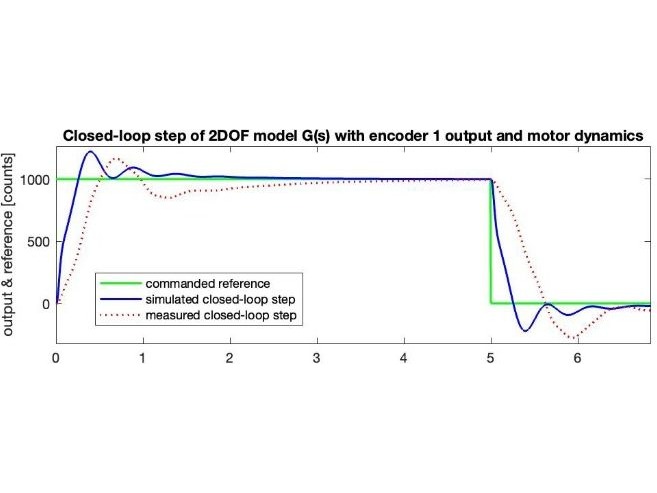
- Designed a PID controller by root locus: proportional gain alone left 63.2% overshoot, so added derivative action for damping and integral action to remove steady-state error.
- Calculated gains reached the setpoint but left residual steady-state error; iteratively increased Ki and Kd to converge on 1000 encoder counts within spec.
Results
- Final tuned gains (Kp=0.2, Ki=0.2, Kd=0.019) produced 20.8% overshoot and a 1.40s settling time on a 1000-count step, meeting the <25% overshoot target.
- Steady-state error converged to 0.1%, versus the calculated gains that failed to settle at the commanded position at all.
Tools & methods
- PID control
- Root locus design
- MATLAB
- DSP real-time control
- System identification
Next project
Deterministic Engineering Tools for AI Assistants